Well Water Testing Rebate
Status: This rebate is now open for 2026.
Property owners with private domestic wells are responsible for the quality of their drinking water supply. By regularly testing your water, you can ensure your well water is safe to consume and that it is not a conduit for contamination to the shared groundwater supply.
This incentive program rebates 50 per cent (up to a maximum rebate of $350) for well water quality tests to applicants that meet the eligibility requirements.
If you meet the eligibility requirements of the rebate listed below, submit a pre-approval application and receive your unique ID number before taking/couriering your sample to a provincially-approved lab.
Documents
Who Can Apply
This rebate program is available to all residential property owners with a private domestic well in the Regional District of Nanaimo (RDN), including Electoral Areas A, B, C, E, F, G and H and member municipalities City of Nanaimo, District of Lantzville, City of Parksville and Town of Qualicum Beach.
Eligibility Requirements
A limited number of rebates are available, funds are allocated on a first-come, first-served basis.
- Must be a residential landowner with a private domestic well within the RDN. Water purveyors and commercial properties are not eligible.
- Well water tests must include both chemical and bacterial analysis, at a minimum the analysis must include the following: Total Coliforms and Escherichia coli (E. coli), pH, Total Dissolved Solids (TDS), Hardness, Nitrate, Nitrite, Sulphate, Fluoride, Chloride, and an elemental metals scan.
- Well water tests must be completed by a provincially-approved lab (see How to get your sample to the lab).
- RDN issued identification number must be submitted to the lab with the well water sample (see Rebate process).
- Each private domestic well is eligible for one rebate every five years.
How the rebate works
Step 1: Submit rebate pre-approval application form
Complete and submit a pre-approval application with wellhead photo(s) to watermonitoring@rdn.bc.ca or mail / drop off to Drinking Water & Watershed Protection, Regional District of Nanaimo, 6300 Hammond Bay Road, Nanaimo, BC, V9T 6N2.
If approved, applicants will receive an RDN issued identification number that must be recorded on your laboratory requisition form and your sample bottles to receive the rebate.
Allow up to six (6) weeks for processing each form.
Step 2: Prepare
- Attend a free webinar or learn more about how to maintain and care for your well, rdn.bc.ca/wellsmart.
- Determine which laboratory and analysis package to select, and how to get your sample to the lab.
- Well water tests must include at a minimum Total Coliforms, Escherichia coli (E. coli), pH, Total Dissolved Solids (TDS), Hardness, Nitrate, Nitrite, Sulphate, Fluoride, Chloride, and an elemental metals scan.
- Pick up water sample bottles from the locations listed under Provincially approved labs for drinking water analysis or contact your selected lab to request a sample package be mailed to you.
- Review the well water sampling procedure, confirm hours and days samples are accepted, and know how to get your sample to the lab within the required timeframe.
Step 3: Taking a water sample
Fill out the lab chain of custody or requisition form, write on your sample bottles the RDN issued identification number, date, time, address, your name, and "RDN Rebate".
Follow the proper sample collection procedures. Take a photo of your sample bottles that clearly show the RDN ID.
Take or courier your sample to the lab, sample must stay below 4 degrees Celsius and be analyzed by the lab within 24 hours of collection.
- Confirm with the lab that the sample package selected includes the correct analysis parameters (Total Coliforms, Escherichia coli (E. coli), pH, Total Dissolved Solids (TDS), Hardness, Nitrate, Nitrite, Sulphate, Fluoride, Chloride, and an elemental metals scan).
- Labs that are third party accredited to analyze drinking water for these parameters are listed in the Provincially approved labs for drinking water analysis section.
Step 4: Receiving your rebate
Once you have paid for the lab analysis and received your results, submit a claim form to the RDN with the required documentation.
If you have met all the program requirements, a cheque for 50 percent off (up to a maximum rebate of $350) will be mailed to the property owner.
How to get your sample to the laboratory
IMPORTANT: Samples must be tested by chosen laboratory within 24 hours of collection from your tap to ensure sufficient microbiology preservation.
Please take sample as shortly as possible before courier drop-off for maximum microbiology retention. When transporting yourself, keep sample in a cooler to maintain a sample temperature of 4°C. Contact lab for a cooler, use your own cooler and arrange return of the cooler with the lab, or use a foam/disposable cooler.
Provincially approved labs for drinking water analysis
Before taking your sample to the laboratory, confirm with them drop-off days and times, as well as when you should take the sample to ensure analysis of the sample within required timeframes. Courier fees are eligible for rebate.
ALS Environmental
- 8081 Lougheed Highway, Burnaby, B.C., V5A 3C8
- 604-253-4188
- How to submit your sample to the lab?
- Email Kevin Bhikadia (kevin.bhikadia@alsglobal.com) to request Chain of Custody (COC) and ensure the correct analysis package is selected.
Bureau Veritas:
- 2755B Moray Avenue, Courtenay, B.C., V9N 8M9
- 250-338-7786
- How to submit your sample to the lab?
- Drive to the lab:
- Bring sample in your own cooler.
- Confirm with receptionist what you would like to sample for, ensuring analysis meets program requirements. Make Payment.
- Use a courier:
- In the shipment, include the Bureau Veritas COC (found here), your contact information, and which analysis you would like (ensuring it meets the program requirements).
- Invoices will be sent, and payments can be made online or via phone.
- Drive to the lab:
Where to get bottles and take your sample
| |||||||||||||||||||||
Well water sampling procedure
Taking a water sample
- Only sterilized, unused bottles can be used.
- Fill out the lab's chain of custody or requisition form that comes with the bottles.
- Well water tests must include at a minimum Total Coliforms, Escherichia coli (E. coli), pH, Total Dissolved Solids (TDS), Hardness, Nitrate, Nitrite, Sulphate, Fluoride, Chloride, and an elemental metals scan.
- Confirm with your lab of choice that the sample package selected includes the correct analysis parameters.
- Write your RDN issued identification number, name, date, time, address, and "RDN Rebate" on your sample bottles.
- Follow the proper sample collection procedures.
Sample procedure summary
- Confirm hours and days samples are accepted with lab/courier.
- Wash hands well and take care not to contaminate your sample.
- Take the sample directly from the tap and, if possible, and remove the aerator.
- Disinfect tap. Run cold water at full force for 2 to 5 minutes.
- Fill the bottle to the fill line or bottom of the neck. Secure lid.
- Place the sample in a clean cooler with ice and lab requisition form.
- Take directly to lab/courier.
Additional details at rdn.bc.ca/water-quality-testing
Your results
Sharing results
When you apply for a Well Water Testing Rebate you agree to share your water quality test results with the RDN, allowing Drinking Water and Watershed Protection program staff to view your water quality results. By sharing your results, you help to enhance the understanding of groundwater quality in the region and contribute to increasing the knowledge base of regional decision makers, supporting water quality trend analysis. Any reporting of results will be anonymous, and none of your personal information will be shared.
On the pre-approval application you can choose to also share your results with the Province of BC for provincial groundwater research. Your personal information will not be shared, only the water quality test result and aquifer location will be shared.
Interpreting your results
Using a third-party accredited and provincially approved laboratory allows homeowners to confidently compare their well water test results to the Canadian Drinking Water Guidelines.
The Canadian Drinking Water Guidelines lay out which parameters have aesthetic objectives (taste, smell, and odour), maximum allowable concentrations for health implications, and/or operational guidelines (potential impacts on water treatment systems).
Frequently Asked Questions
What is a private domestic well?
A private domestic well provides water for household and garden use at an individual dwelling. If a well provides water for more than one dwelling, it is not considered a private domestic well. Domestic water use includes:
- household drinking water, food preparation and sanitation,
- fire prevention,
- water for animals or poultry kept for household use, or as pets,
- irrigation of a garden or lawn that does not exceed 1,000 m2 on the same parcel or a parcel immediately adjacent to the dwelling.
Any other uses are considered non-domestic and require a Groundwater License from the Province.
When should I get my water tested?
In the region, approximately 42 per cent of residents depend on groundwater for drinking water; many of these residents have their own private well that they manage. Improperly constructed or poorly maintained wells can act as a direct pathway for surface contaminants such as manure, petroleum products, and fertilizers to enter the groundwater. To assist residents in maintaining and improving groundwater quality in rural areas, the RDN incentives sampling of private domestic wells through the Well Water Testing Rebate (rebate).
Island Health recommends bacteria testing one to three times a year. Ideally, tests are performed during high rains when surface water could more readily contaminate groundwater, whenever major work is completed on main plumbing lines, the well pump or wellhead; or whenever someone with decreased immune functions will be consuming your well water (e.g., elderly, young children, auto-immune disorder, etc.). Full chemical analysis is recommended every three to five years, or if you notice a change in your water quality.
What is the difference between a dug and a drilled well?
Dug and drilled wells differ in construction method.
A dug well is formed by excavating the ground with hand tools, backhoes, or excavators. They are typically wide (3 m in diameter) and shallow (less than 30 feet deep). To prevent the collapse of materials into the well, stone, brick, or concrete rings are used to case the well.
A drilled well is created with drilling equipment that bores a narrow (6 to 8 inches in diameter), deep (over 50 feet deep) hole. A steel casing is installed into the bore hole to prevent materials entering the well. If the well source is in sand and gravel (overburden materials) it will also have a screen installed to allow water into the well.
Where can I find my well ID number?
Each well can have up to two identification numbers with the province. All groundwater wells drilled after the Water Sustainability Act (2016) came into effect will have both identification numbers assigned: the well plate ID and a well tag number.
The well plate ID number is a metal plate the well driller attaches to the wellhead when the well is drilled or upgraded. A well tag number is assigned when the province processes the drillers log submitted by the well driller and uploads the well record to the provincial Groundwater Wells Database.
If your well does not have a provincial plate ID or your well is not listed on the groundwater wells database, click here to learn more about well registration.
Why do I have to use a provincially approved lab?
For the rebate voucher to be honoured, samples must be taken to a provincially approved lab.
Under the Environmental Management Act (2003) regulation, an approved laboratory means a laboratory registered with the Canadian Association for Laboratory Accreditation (CALA) as participating in the Association’s Inter-laboratory Comparison Program. CALA maintains a Directory of Accredited Laboratories (directory) which based on the Associations’ Inter-laboratory Comparison Program’s proficiency testing, are competent to perform specified chemical analyses. The directory is essentially a subset of the larger CALA Directory, comprised primarily of CALA accredited laboratories located in British Columbia and Alberta.
There are two provincially approved labs that samples can be couriered or taken to. One of these is on Vancouver Island: Bureau Veritas Laboratories and one is on the mainland: ALS Environmental.
For a full list of accredited labs in British Columbia, visit nrs.gov.bc.ca/qualified-labs.
Where can I learn more about groundwater and water testing?
- BC Environmental Management Act (2003)
- BC Registry Search for a Qualified Well Driller or Well Pump Installer
- BC Water Sustainability Act (2016)
- Canadian Drinking Water Guidelines
- Drinking Water resources and concerns (Island Health)
- Groundwater Protection and Sustainability (BC Ministry of Environment)
- Groundwater Protection Regulation Handbook (BC Ground Water Association)
- Groundwater Wells Database (BC Ministry of Environment)
- Information for Property Owners (BC Ministry of Environment)
- Well Registration Form (BC Ministry of Environment)
- Wellhead Upgrades Rebate (RDN)
- WellSmart Education Program (RDN)
The vision of the RDN's Drinking Water & Watershed Protection program is for healthy, safe, and resilient water resources in the region. Learn more at dwwp.ca
For additional inquiries, call 250-390-6560 or email watermonitoring@rdn.bc.ca
DWWP Water Stewardship Rebates Map
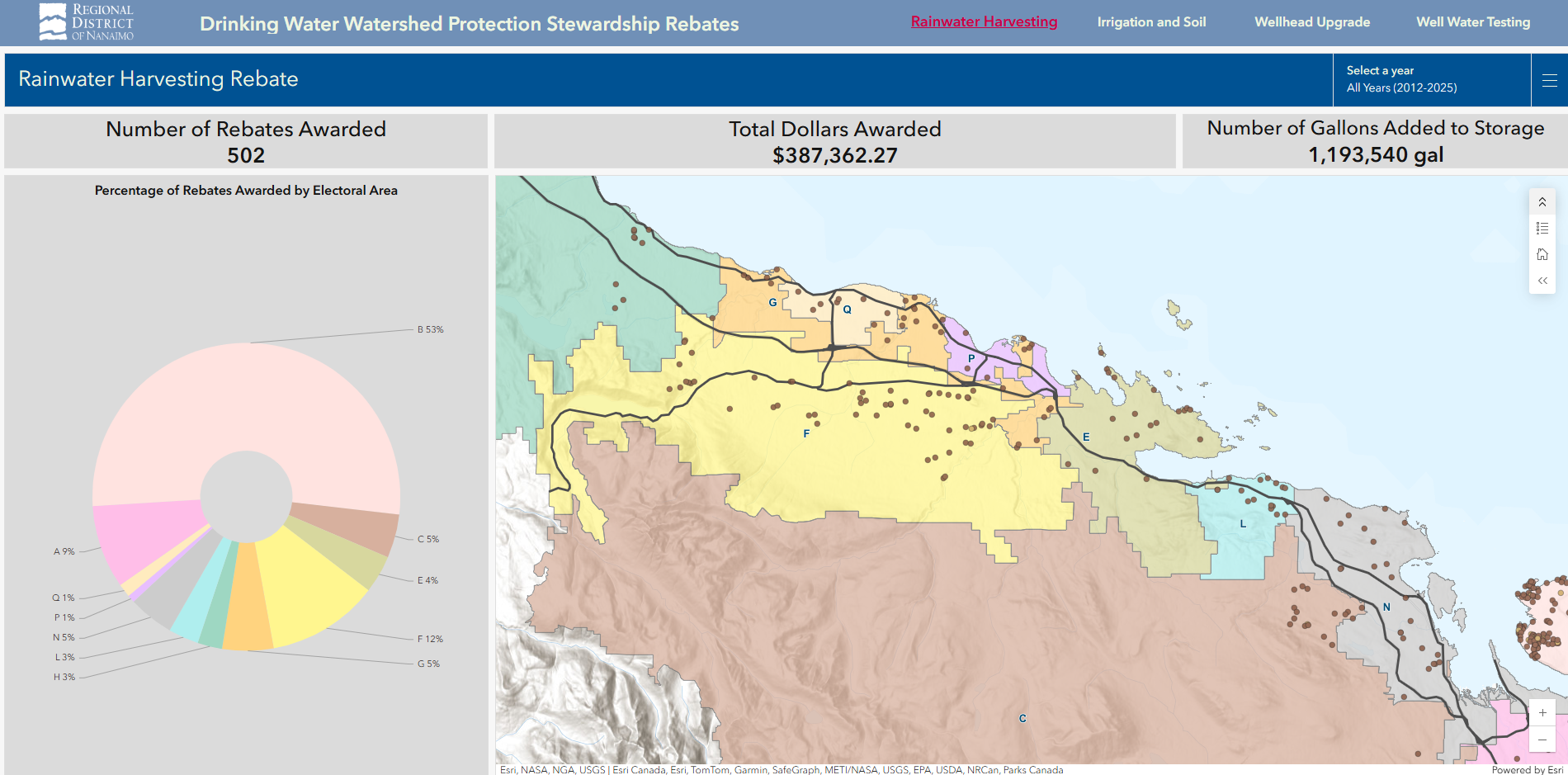
New! Learn more about RDN Water Stewardship Rebates supported by the Drinking Water & Watershed Protection program with this interactive web map.
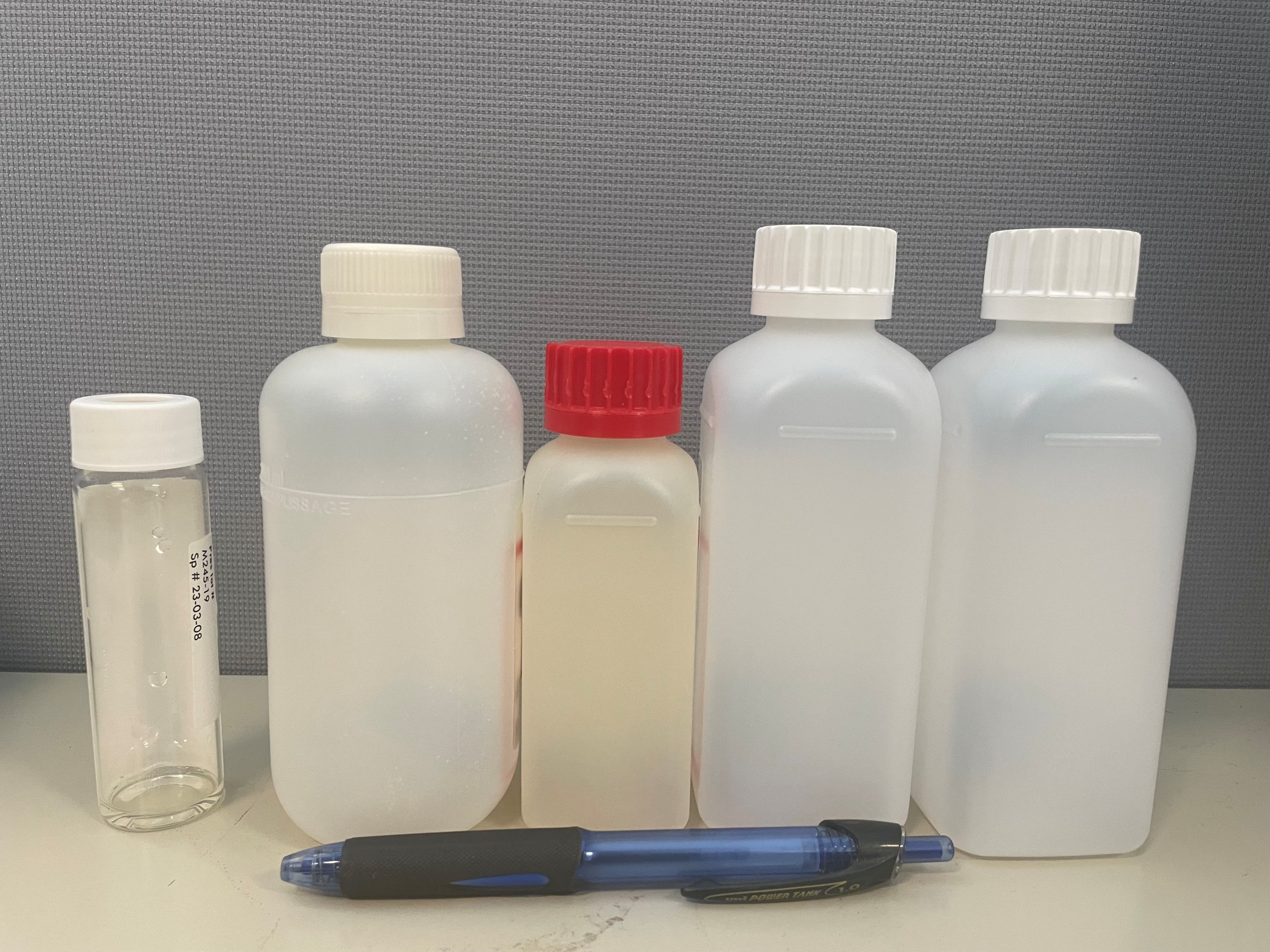
Example of sample bottle package used for Well Water Testing Rebate (note: bottle number and size may vary depending on the chosen analysis package, please confirm with the laboratory of your choosing that you have the correct sample bottles).